Mostrando entradas con la etiqueta Albert Edelfelt. Mostrar todas las entradas

martes, 5 de marzo de 2013

Grand Duchy of Finland 2° part

Second part: romanticism and Finnish nationalism

Finnish identity

Like in the whole Europe, the XIX Century was characterized by the revolutions and the affectation of these on the arts, besides an ideology was created to help subjugated nations to obtain their independence and Finland was one of this nations. During the second half of 19th century, the University of Helsinki was cradle of great painters, writers, poets and musicians that would developed the Finnish romanticism; those artists searched to create artworks and define an own identity, something that characterized them as Finns.

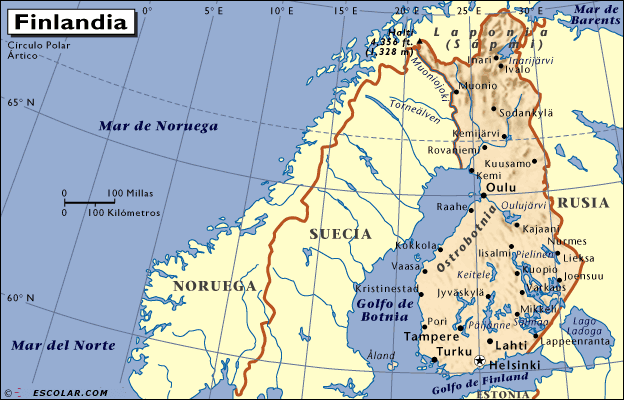
To start with the Finnish identity it’s necessary to set the country geographically: for Ángel Ganivet, Finland is in disadvantage because of its geographical position, since on the right it has to the “Colossus of the North” (Russia) and on the left it has the lion that pounce over Europe (Sweden),[1] but for me this is not a disadvantage, but the opposite, because Finland can be influenced by the occidental culture represented by Sweden and by the oriental culture by Russia, having a melting pot of cultures and a combination of them that make of Finnish culture, an unique one.

The “russification”

Due to the huge attributions that Finland had inside the Empire, the nationalists Russians started to criticize this situation, also the relation that the Duchy had with the rest of Europe.[2] This had as consequence the first period of russification; in this period, Russia tried to attract the Great Duchy to the influence sphere, that caused a confrontation between the Finnish elite and the Russian government.[3] In 1899 tsar Nicholas II started an attack against Finnish sovereignty, that wouldn’t stop until 1905,[4] with the dissolution of its army, the establishment of Russian as an official language, just as the decrease of the Finnish Diet power and at last the repression.[5] This brought with it the disappearing of the privileges and customs, under the slogan of smoothness and russification of the territories.


National painting, literature and music

The painting as a mirror of nationalism

Along the 19th century painting played an important role to the develop of nationalism; Albert Edelfelt was a very important representative of this art, his capital work is the portrait of Louis Pasteur, demonstrating with this the importance that Finland had on the European sphere. Nevertheless on his works we can see the leading nationalism in the country at the end of the century, as is viewed on the painting Paris in the snow, where the Parisian landscape is mostly alike a Finnish one, on the work snow plays an important paper and we can see it even on the name, an artwork where the buildings viewed aren’t typical from Paris and the landscape could be a city inside the Nordic country. I can’t talk about the representative monument of Paris, because when Edelfelt painted this artwork, the Eiffel tower was in the beginning of its building.

Is in this period where the first factories start to come to Finland and once again, this is seen on the painting because of the economic-industrial development of the country, and also it’s the start of the first nationalist signs, same that were shown in every possible way.


Another figure on the Finnish romanticism is Akseli Gallen-Kallela, with the frescos that he painted about Kalevala, the Finnish epic poem, those artworks are colossal, and not only because of the size but for the technique and nationalism, because even for the topic those are nationalist artworks. Inside these pieces passages of Kalevala can be viewed, that represent the fight of Finns against Russians, the first fighting fo their independence and the second defending their interests. This painting is The defense of the Sampo (Sammon puolustus).


Another pictorial piece where this fight is seen is The attack (Hyökkäys), where the theory of nationalities is there, here the painter expressed Finland as a beautiful lady being attacked by a two-headed eagle, the same that represents the Russian Empire. In this work is illustrated in a clear and direct way the trying to russification by the empire, and the protest was loud and clear.


With their works “Finns wanted to show also through their art that Finland could have an independent existence in the concert of the European nations.”[6] And this was reflected on the Universal Exposition, which took place in Paris in 1899, where Finland was welcomed in its exclusive pavilion. There the country “emphasize its own nature and its definition in relation with Russia caused some conflicts […] the pavilion and Finland’s art caused an important political attention, in whose background was the institutional conflict between Russia and Finland.”[7] Along this period Finland started to have a more active role inside the European continent.


Kalevala

One on the first nationalist-romantic demonstration is Kalevala, the Finnish epic poem; according to Ángel Ganivet this creation is the most important of the Finnish nationalism,[8] and he has right because this is the world view of a subjugated people, this is the origin of the population, is the fight between men and inhumane weather predominant in Finland. The first edition of the book was in 1835 and it was conformed by about 5,000 verses and in 1849 was edited definitely, con more that 23,000 verses, gathered in 50 chants.[9]


This series of ancient chants were compiled by a medic named Elias Lönnrot, who spent a long time of his life going through the Karelian zones hearing and taking notes of all the poems, these would get a capital importance, because with the Kalevala the existence and specific character of the Finns will be known.[10]


Nevertheless, “what made Kalevala so meaningful wasn’t its content and language but the fact that Finns were capable to realize such a cultural achievement.”[11] And this is right, because Finland was subjugated so much time and besides it had a significant impact on the language, considering that after the publishing of the book, J. V. Snellman, demanded the establishment of Finnish language as the one of the administration and culture, which meant a compromise with Finnish people.[12]


Maamme (Our Land)

The nationalism that we have been talking about can be viewed also in the poem written by Johan Ludvig Runeberg, although it was originally written in Swedish, is nowadays the national anthem of Finland. As you can see in the first quote of this work, the poem talks about Finnish nature, about how is Finland, and in resume, it is the exaltation of a land that even if it was poor, it was the land that saw the Finns born,[13] since although for Russians or Swedes this land didn’t give economic yields, for Finns this is the best land of the world.


This is also reflected on the work that Jean Sibelius composed at the end of 19th century, Finlandia. This musical piece is the creation of an image of greatness, of a great Finland, full of gifts, where a great prosperity is and above all, where Finns are, all of this through the sounds is.


As a conclusion

As we can see, the general situation of Finland during the XIX century gave way to the birth of a well justified nationalism, this is represented by a popular proverb of that period: “Swedes we are not and Russians we do not want to be, let’s be Finns then.”[14] With this words the huge feeling of love to the fatherland born in this century can be noticed, since although the country and their inhabitants enjoyed of enormous privileges under the Russian domain, Finns didn’t feel comfortable being a part of Russian and the demonstrations appeared among the XIX century and mainly during the second half were not spontaneous.

One of the reasons of these events was the fact that Russia, seeing the growing and prosper relations between Finland and the rest of Europe and besides the Finns started to have more independence, Russians dedicated to “russificate” Finland. One of those attempts to the Finnish autonomy was the establishment of Russian as an official language, displacing Finnish and Swedish, this was an insult to the elite, because they had worked so much establishing Finnish as an official language.


Probably one of the mistakes of Russia was give Finland many attributions, but the Empire had to secure the loyalty of Finland Estate in some way and giving to the Finnish a better life quality than the one they had with Sweden was an important manner to keep that loyalty. Nevertheless, this was only in theory, because the most part of the Finns kept living in precarious conditions:

“the rebirth of Finnish literature, the political constitution of Finland, the foundation of the nationalist party or Finnish party, are result of Russian domination, which couldn’t aspire to a quick integration of this country to the mother country, it keeps neutral between the two constitutive forces, the national and the Swedish, and allows that the first force became proprietor of the situation.”[15]

Another fact that moved the Finns to develop their own national identity was the language: during the whole history of Finland, Finnish was the vulgar language, being Swedish the official one. Nevertheless in the moment that Finland became a part of Russia, Swedish stayed there, but Finnish started to have more presence caused by the publishing of Kalevala; its compiler, Elias Lönnrot was the first Finn of the elite that made Finnish his mother tongue, being himself a conjuncture to the later publishes of books and poems in Finnish. This is really important, because with the work of Lönnrot not only the roots of Finland as a nation were taken up again, but also the language of the country was developed, the one that always was the language of the people, the vulgar language, and as Ángel Ganivet writes:

“Russian authority is convenient; the Swedish language could be stay as an interim way of intellectual communication; but the spirit of the country only can reach its highest height picking up itself and ‘thinking in its natural language’, set and dignified by creations of great value like Kalevala.”[16]

And I agree with Ganivet, because this work is beautiful, is an exaltation of the land, is the defense of the national against the foreign, watching it from the romantic view, it doesn’t simulate nothing that brags as romantic; through out all the verses, the main idea is the fight between the sons of Kaleva, that can be the Finns, against the army of Pohjola, that can be the Russians or the Swedes.


The Finnish identity is permeated by the fact that this people doesn’t belong to the Baltic race, nor Indo-European, the Finn race and also the language is odd and the only relatives they have in Europe are the Hungarians and Estonians, this made that Finns didn’t feel identified with the Russians, nor the Swedes, this took them to search an own identity, something that made them different from other people. Besides failing Russia on establishing its dominance over an ethnic and linguistic basement, they couldn’t homogenize the population. Because of this “Finnish nationalism had as basement the national language and culture, a strong estate and vigorous national identities.”[17]

Something that must be cleared is the fact that the work of Jean Sibelius was highly accepted by the people (even more than Runeberg), but strongly criticized and suppressed by Russins and the were right, because through all the verses of the poem (written years later than the musical composition) there are lines full of nationalism, there is Finland; Finns didn’t want to belong to Russia, and that, along the great relations the intellectual class had all over Europe, and the influence of European ideas, took them to shelter on the theory of nationalities and search for the independence and according to this, Finland was already prepared to search it because they had an own language, an own religion, an own literature and arts. And it’s because of that when the Finnish independence was threatened in Second World War, this feeling was present once again:

“Oh, rise, Finland, rise up high!

Your head, wreathed with great memories
Oh, rise, Finland, show to the world
The you drove away the slavery,
And that you didn’t give up to oppression
Your day has come, land of birth.”[18]


To me there is no better way to call a subjugated people to search for independence than through the music, because music is universal and it doesn’t understand about borders, and it’s because of this that the Opus no. 26 of Sibelius is more loved in Finland than Mamme, and even when Runeberg’s poem is a nationalist work, Finlandia is even more because this was written in Finnish and not in Swedish, so the people was called in their own language and not in one that doesn’t belong to them. Besides the call was really direct, if this poem never mention about Russians, it does about oppression and slavery, this was not only the calling to defend the father land, but also the extension of social reality, is in this moment when the sovereignty is threatened at the Second World War and it was necessary to escape from Russians.

To close this work, Finland played an important role to the security of the Russian Empire in XIX century, besides it has a huge intellectual and ideological development, which easily could compete with other European powers. All of this is result of the great autonomy the country had under Russian dominance, autonomy that led the country to be the first European nation in giving the vote to women, led Finland to develop industries as important nowadays as Nokia; same development that made of Finland nowadays one of the most prosper nations economic, politic, educative and socially.



[1] Ganivet, op. cit., p.16.
[2] Klinge, op. cit., p. 87.
[3] Ibidem., p. 104.
[4] Sumner, op. cit., p. 105.
[5] S.A., op. cit, p. 20.
[6] Sakari Saarikivi, “El arte moderno”, en V.V.A.A., Finlandia, ayer y hoy, Madrid, Espasa-Calpe, trad. Alfonso Reta y Felipe Ximénez de Sandoval, 1973, p. 154.
[7] Klinge, op. cit., p. 105.
[8] Ganivet, op. cit., p. 139.
[9] Elias Lönnrot, Kalevala, Madrid, Alianza Editorial, prol. Agustín García Calvo, trad. Joaquín Fernández y Úrsula Ojanen, 2004, p. 34.
[10] Klinge, op. cit., p. 70-72.
[11] Ibidem., p. 72.
[12] S.A., op. cit., p. 19.
[13] Runeberg, op. cit., p. 6.
[14] Juva, op. cit., p. 66.
[15] Ganivet, op. cit., p. 66.
[16] Ibidem., p. 14-15.
[17] S.A., op. cit., p. 32.
[18] S.A., Finlandia Hymni, (DE 7 de octubre de 2011, 08:01 p.m., en http://www.suomifanit.com/pages.php?page=laulukirja) text translated from Finnish by Anahí Sandoval: Oi nouse, Suomi, nosta korkealle/pääs' seppelöimä suurten muistojen,/oi nouse, Suomi, näytit maailmalle/sa että karkoitit orjuuden/ja ettet taipunut sa sorron alle,/on aamus' alkanut, synnyinmaa. 

lunes, 14 de enero de 2013

El Gran Ducado de Finlandia 2° parte


Segunda parte: el romanticismo y el nacionalismo finlandés

Identidad finlandesa

Al igual que en toda Europa, el siglo XIX se caracterizó por las revoluciones y la afectación de éstas en las artes, además se creó una ideología que ayudaría a naciones sometidas a obtener su independencia y Finlandia fue una de esas naciones. Durante la segunda mitad del siglo XIX y la Universidad de Helsinki fue cuna de grandes pintores, escritores, poetas y músicos que desarrollarían el romanticismo finlandés; éstos artistas buscaron crear obras de arte y definir una identidad propia, algo que los caracterizara como finlandeses.

Para comenzar con la identidad finlandesa hay que ubicar al país  geográficamente: para Ángel Ganivet, Finlandia se encuentra en desventaja por su ubicación geográfica, ya que a la derecha tiene al "Coloso del Norte" (Rusia) y a la izquierda al león que se abalanza sobre Europa (Suecia),[1] pero esto no es desventaja, sino lo contrario, ya que Finlandia puede estar influenciada por la cultura occidental, representada por Suecia y por la cultura oriental, en el caso de Rusia, teniendo así, un crisol de culturas y una combinación de las mismas que hacen de la finlandesa, una cultura única.


Intento de rusificación

Debido a las enormes atribuciones que tenía el país dentro del Imperio, los rusos nacionalistas comenzaron a criticar esta situación, así como la relación de Finlandia con el resto de Europa.[2] Esto trajo como consecuencia el primer período de rusificación; en este lapso, Rusia trató de atraer al Gran Ducado a su esfera de  influencia, lo que provocó un enfrentamiento entre la élite finlandesa y el gobierno ruso.[3] Para 1899 el zar Nicolás II abrió un ataque contra la soberanía finlandesa, mismo que se detendría en 1905,[4] con la disolución de su ejército, la implantación del ruso como lengua oficial, así como la disminución del poder de la Dieta finlandesa y por último la represión.[5] Esto trajo consigo la desaparición de los privilegios y las costumbres, bajo la consigna de la uniformidad y rusificación de los territorios.


Pintura, literatura y música nacionales

La pintura como espejo del nacionalismo

Durante el siglo XIX la pintura jugó un papel muy importante para el desarrollo del nacionalismo; Albert Edelfelt fue un representante muy importante de éste arte, su obra capital es el retrato de Luis Pasteur, lo que demuestra la importancia de Finlandia dentro del ámbito europeo. Sin embargo a lo largo de sus obras bien se puede ver el nacionalismo que reinaba en Finlandia a finales de éste siglo, como se puede ver en la pintura París en la nieve, donde el paisaje parisino más parece uno finlandés, aquí la nieve juega un papel importante, y lo podemos ver hasta en el nombre, una pieza donde las construcciones que se observan no son típicas parisinas y más bien podría parecer alguna ciudad al interior del país nórdico e incluso podría ser la ciudad natal del artista. No se puede hablar del monumento representativo de París, puesto que para cuando el artista realizó la obra, la torre Eiffel apenas comenzaba su construcción.

Es en éste momento cuando comienzan a llegar las primeras fábricas al país y una vez más, esto se puede observar en la pintura, ya que el desarrollo económico-industrial del país y al mismo tiempo de las primeras consignas nacionalistas, mismas que fueron mostradas en todos los aspectos posibles.


Otro representante del romanticismo pictórico finlandés es Akseli Gallén-Kallela, con los frescos que realizó sobre el Kalevala, la epopeya épica finlandesa, éstas obras de tamaño colosal, no sólo lo son en cuanto a tamaño, lo son en cuanto a técnica y nacionalismo, ya que, desde el tema tratado son obras nacionalistas. Dentro de éstas piezas se pueden observar pasajes del Kalevala, que representan la lucha de los finlandeses contra los rusos, los primeros peleando por su independencia; los segundos defendiendo sus intereses. La obra que se ve a continuación es La defensa del Sampo (Sammon puolustus).


Otra obra pictórica en la que se puede observar esta lucha es El ataque (Hyökkäys) del pintor Eetu Isto, en dónde se hace muy presente la teoría de las nacionalidades, aquí el pintor plasmó a Finlandia como una hermosa doncella, que es atacada por un águila bicéfala, misma que representa al imperio ruso. En esta obra se ilustra de una manera clara y directa el intento de rusificación por parte del imperio, y la protesta no pudo ser más clara.


Con sus obras "los finlandeses querían mostrar también a través de su arte que Finlandia podía disponer de una existencia independiente en el concierto de las naciones europeas."[6] Y esto se vio reflejado en la Exposición Universal, llevada a cabo en París en el año de 1899, donde Finlandia fue recibida en su pabellón exclusivo. Ahí el país "subrayó su propia índole y su definición con respecto a Rusia causó ciertos conflictos [...] el pabellón y el arte de Finlandia provocaron una importante atención política, en cuyo trasfondo se encontraba el conflicto institucional entre Rusia y Finlandia."[7] Durante éste período se puede observar que Finlandia comenzó a tener un papel más activo dentro del continente europeo.


Kalevala

Una de las primeras manifestaciones nacionalista-románticas es el Kalevala, la epopeya épica finlandesa; según Ángel Ganivet ésta creación es la manifestación más importante del nacionalismo finlandés,[8] y bien tuvo razón ya que ésta obra es la cosmovisión de un pueblo sometido, es los orígenes de ese pueblo, es la lucha entre el hombre y el clima inhumano predominante en Finlandia. La primera edición del libro fue en 1835 y constaba de poco más de 5,000 versos y para 1849 se editó de manera definitiva, con más de 23,000 versos, agrupados en 50 cantos.[9]


Ésta serie de cantos antiguos fue recopilada por un médico llamado Elias  Lönnrot, quien se pasó gran parte de su vida recorriendo las zonas carelianas escuchando y tomando notas de todos los poemas, mismos que adquirirían una importancia capital, ya que sería mediante el Kalevala que se daría a conocer la existencia y el carácter específico de los finlandeses.[10]


Sin embargo, "lo que hizo tan significativo el Kalevala no fue tanto su contenido y su lenguaje como el hecho de que los finlandeses fueran capaces de realizar semejante logro cultural."[11] Y esto es correcto, ya que Finlandia estuvo mucho tiempo sonetos y además tuvo un impacto significativo en cuanto a la lengua, ya que después de la publicación del libro, J.V. Snellman, exigió la implantación del finés como lengua de la administración y la cultura, lo que significaba un compromiso con el pueblo finlandés.[12]


Maamme (Nuestra tierra)

Ese nacionalismo también se puede notar en el poema escrito por Johan Ludvig Runeberg, que aunque escrito originalmente en sueco, es actualmente el himno nacional de Finlandia. Como se puede ver en la cita inicial de éste trabajo, el poema habla sobre la naturaleza finlandesa, sobre cómo es Finlandia y, en resumidas cuentas, es la exaltación de una tierra que aunque pobre, es la torre que vio nacer a los finlandeses,[13] ya que si bien, para los rusos o los suecos esta tierra no daba muchos réditos económicos, para los finlandeses es la mejor tierra del mundo.


Esto también se ve reflejado en la obra que Jean Sibelius compuso a finales del siglo XIX, Finlandia. Ésta pieza musical es la creación de una imagen de grandeza, de una Finlandia grande, llena de dones, donde hay una gran prosperidad y sobre todo, donde hay finlandeses, todo esto a través de los sonidos. Actualmente en el país existe una consigna de que el opus no. 26 de Sibelius sea el himno nacional, ya que la letra, aunque posterior, habla sobre el despertar del nacionalismo finlandés y sobre todo, del despertar de una nación.[14]


A modo de conclusión

Como podemos ver, la situación general de Finlandia durante el siglo XIX dio paso al nacimiento de un nacionalismo bien fundamentado, cosa que se puede ver en un dicho popular de ese siglo: "suecos no somos y rusos no queremos ser, entonces seamos finlandeses."[15] Con ésta consigna podemos notar el enorme sentimiento de amor a la patria surgido durante el siglo XIX, ya que si bien, el país y sus habitantes gozaron de enormes privilegios bajo el dominio ruso, los finlandeses no se sentían bien siendo parte de Rusia, y las manifestaciones surgidas a lo largo del siglo XIX y principalmente durante la segunda mitad no fueron espontáneas.

Una de las causas de éstos acontecimientos fue el hecho de que Rusia, al ver que Finlandia tenía relaciones crecientes y prósperas con el resto de Europa y que los finlandeses empezaran a tener una mayor independencia, se dedicaran a "rusificar" a Finlandia. Uno de esos "atentados" a la autonomía finlandesa fue el que se instituyera el ruso como lengua oficial, desplazando al finés y al sueco, hecho que para los habitantes fue un agravio, ya que les había costado mucho el que se instituyera el finés como lengua oficial.


Probablemente uno de los errores de Rusia fue haberle dado a Finlandia demasiadas atribuciones, pero Rusia tenía que asegurar la fidelidad del Estado finlandés de algún modo y el darle a los finlandeses una mejor calidad de vida de la que habían tenido con Suecia fue una manera importante de mantener esa fidelidad. Sin embargo, esto solo fue en teoría, ya que la mayor parte de los finlandeses siguieron viviendo en condiciones precarias:

"el renacimiento de la literatura finlandesa, la constitución política de Finlandia, la formación del partido nacionalista o finlandés, son obra de la dominación rusa, la cual, no pudiendo aspirar a una asimilación rápida de éste país a la metrópoli, se mantiene neutral entre las dos fuerzas constitutivas, la nacional y la sueca, y permite así que la primera se haga dueña de la situación."[16]

Otro de los hechos que motivó a los finlandeses a desarrollar su propia identidad nacional, fue la lengua: durante toda la historia de Finlandia el finés fue la lengua vulgar, siendo el sueco la lengua oficial del país. Sin embargo al momento de pasar a manos rusas, el sueco se siguió conservando, pero el finés comenzó a tener una mayor presencia provocada por la publicación, del Kalevala; su recopilador, Elias Lönnrot, fue el primer finlandés de la élite en hacer del finés su lengua madre, siendo él un parteaguas, para la posterior publicación de libros y poemas en finés. Esto es muy importante, ya que con la obra de Lönnrot no solo se retomaron las raíces de Finlandia como nación, sino que se desarrolló la lengua del país, que había sido siempre la del pueblo, la lengua vulgar, ya que como apunta Ángel Ganivet:

"La autoridad rusa es conveniente; la lengua sueca podrá quedar como medio supletorio de comunicación intelectual; pero el espíritu del país sólo puede llegar a su máxima altura recogiéndose sobre sí mismo y 'pensando en su natural idioma', fijado ya y ennoblecido por creaciones de tan subido valor como el Kalevala."[17]

Y estoy de acuerdo con el señor Ganivet, ya que ésta obra es hermosa, es una exaltación de la tierra, es una defensa de lo nacional a lo extranjero, viéndolo desde el punto de vista romántico, no se asemeja a nada que se jacte de serlo, a lo largo de todos los versos, la idea principal es la lucha entre los hijos de Kaleva, que podrían ser los finlandeses, contra las huestes de Pohjola, que bien podrían ser los suecos o los rusos.


La identidad finlandesa se ve permeada por el hecho de que éste pueblo no pertenece a la raza báltica, ni a la indoeuropea, la raza finlandesa y también la lengua es impar y lo únicos primos que tienen en Europa, son los húngaros y los estonios, esto hizo que los finlandeses no se sintieran identificados con los rusos, ni con los suecos, lo que los llevó a buscar una identidad propia, algo que los diferenciara de ambos pueblos. Además de que Rusia al no haber constituido su dominio sobre una base étnica y lingüística, no pudo homogeneizar a su población. Por lo cual "el nacionalismo finlandés tuvo como bases el idioma y la cultura nacionales, un estado fuerte y vigorosas identidades nacionales."[18]

Otra de las cosas que son rescatables es el hecho de que la obra de Jean Sibelius fue sumamente aceptada por el pueblo (incluso más que la de Runeberg) pero fuertemente criticada y reprimida por los rusos y bien tuvieron razón los rusos, ya que a lo largo de toda la letra de éste poema (escrito posteriormente a la composición musical), se pueden encontrar versos llenos de nacionalismo, versos llenos de Finlandia; los finlandeses ya no querían ser parte de Rusia, y eso, junto con las grandes relaciones que tenía la clase intelectual en Europa, y por ende la influencia que las ideas europeas tenían sobre ésta clase, los llevó a refugiarse en la teoría de las nacionalidades y buscar su independencia y conforme a esto, Finlandia ya estaba preparada para buscar su independencia y conforme ésta teoría, el país ya estaba preparado para buscar una emancipación, ya que poseían un idioma, una religión, una literatura y artes propias. Y es por eso que cuando la independencia finlandesa se vio amenazada en la segunda guerra mundial, éste sentimiento se hizo nuevamente presente:

"¡Oh, despierta, Finlandia, levántate muy alto!
Tu cabeza se corona con grandes pensamientos
¡Oh, despierta, Finlandia, muéstrale al mundo!
Que te zafaste de la esclavitud
Y que no te rendiste a la opresión
Tu mañana ha empezado, patria."[19]


Para mi no hay mejor manera de llamar a un pueblo sometido a buscar la independencia que por medio de la música, porque la música es universal y no entiende de fronteras, es por eso que el opus no. 26 de Sibelius es más querida en Finlandia que el propio himno nacional, ya que aunque la obra de Runeberg, Maamme es una obra nacionalista, Finlandia lo es más ya que fue escrita en finés y no en sueco, por lo que se llamó al pueblo en su propio idioma y no en uno que ni les pertenecía. Es por eso que Finlandia tiene más valor que Maamme. Además de que esa llamada fue muy directa, si bien nunca hace mención de los rusos, si hace mención a la opresión y a la esclavitud, no sólo fue el llamado a la independencia, sino que también es la extensión de la realidad social que se vivía, justo éste es el momento en que la rusificación comienza a hacerse presente y la clase intelectual del país comienza a hacer su nacionalismo más presente con obras como ésta y con pinturas como las mencionadas anteriormente.

Para finalizar, Finlandia jugó un papel importante para la seguridad del Imperio Ruso en el siglo XIX, además de que tuvo un gran desarrollo intelectual e ideológico, que bien pudo competir con otras poten las europeas. Todo esto es resultado de la enorme autonomía que tuvo bajo el dominio ruso, autonomía tal que llevó al país a ser la primera nación europea en otorgar el sufragio universal a las mujeres, llevó a Finlandia a ser una nación próspera económicamente (a pesar de ser un país agrario) y a desarrollar industrias tan importantes hasta nuestros días como Nokia; mismo desarrollo que hoy en día hacen de Finlandia la nación más próspera económica, social, política y educativamente.


[1] Ganivet, op. cit., p. 16.
[2] Klinge, op. cit., p. 87.
[3] Ibídem., p. 104.
[4] Sumner, op. cit., p. 105.
[5] S.A., op. cit., p. 20.
[6] Sakari Saarikivi, “El arte moderno”, en V.V.A.A., Finlandia, ayer y hoy, Madrid, Espasa-Calpe, trad. Alfonso Reta y Felipe Ximénez de Sandoval, 1973, p. 154.
[7] Klinge, op. cit., p. 105.
[8] Ganivet, op. cit., p. 139.
[9] Elias Lönnrot, Kalevala, Madrid, Alianza Editorial, prol. Agustín García Calvo, trad. Joaquín Fernández y Úrsula Ojanen, 2004, p. 34.
[10] Klinge, op. cit., p. 70-72.
[11] Ibídem., p. 72.
[12] S.A., op. cit., p. 19.
[13] Runeberg, op. cit., p. 6.
[14] S.A., Finlandia, (DE 7 de octubre de 2011, 09:20 p.m., en http://www.sibelius.fi/english,musiikki/ork_finlandia.htm)
[15] Juva, op. cit., p. 66.
[16] Ganivet, op. cit., p. 66.
[17] Ibídem., p. 14-15.
[18] S.A., op. cit., p. 32.
[19] S.A., Finlandia Hymni, (DE 7 de octubre de 2011, 08:01 p.m., en http://www.suomifanit.com/pages.php?page=laulukirja) texto traducido del finés por Anahí Sandoval: Oi nouse, Suomi, nosta korkealle/pääs' seppelöimä suurten muistojen,/oi nouse, Suomi, näytit maailmalle/sa että karkoitit orjuuden/ja ettet taipunut sa sorron alle,/on aamus' alkanut, synnyinmaa.